I've Been on Both Sides of This Table
Before getting into the nuts and bolts, a disclosure: I spent eight years on the manufacturing side before moving into brand consulting. I've sat in the meetings where factory sales reps tell a prospective client "no problem, we can do that" about a formulation they've never produced. I've also sat across from factory owners who genuinely care about the products leaving their floor but can't articulate that to a brand owner who doesn't speak "manufacturing."
This guide isn't theory. It's the stuff I wish someone had told me before I signed my first contract.
Start Here: Figure Out What "Right" Actually Means for You
Most brand owners jump into sourcing with a spreadsheet of factories before defining what success looks like for their specific situation. The right manufacturer for a startup launching one serum at 500 units is not the same as the right manufacturer for an established brand running 20,000-unit production runs across six SKUs.
Get specific about three things before contacting anyone:
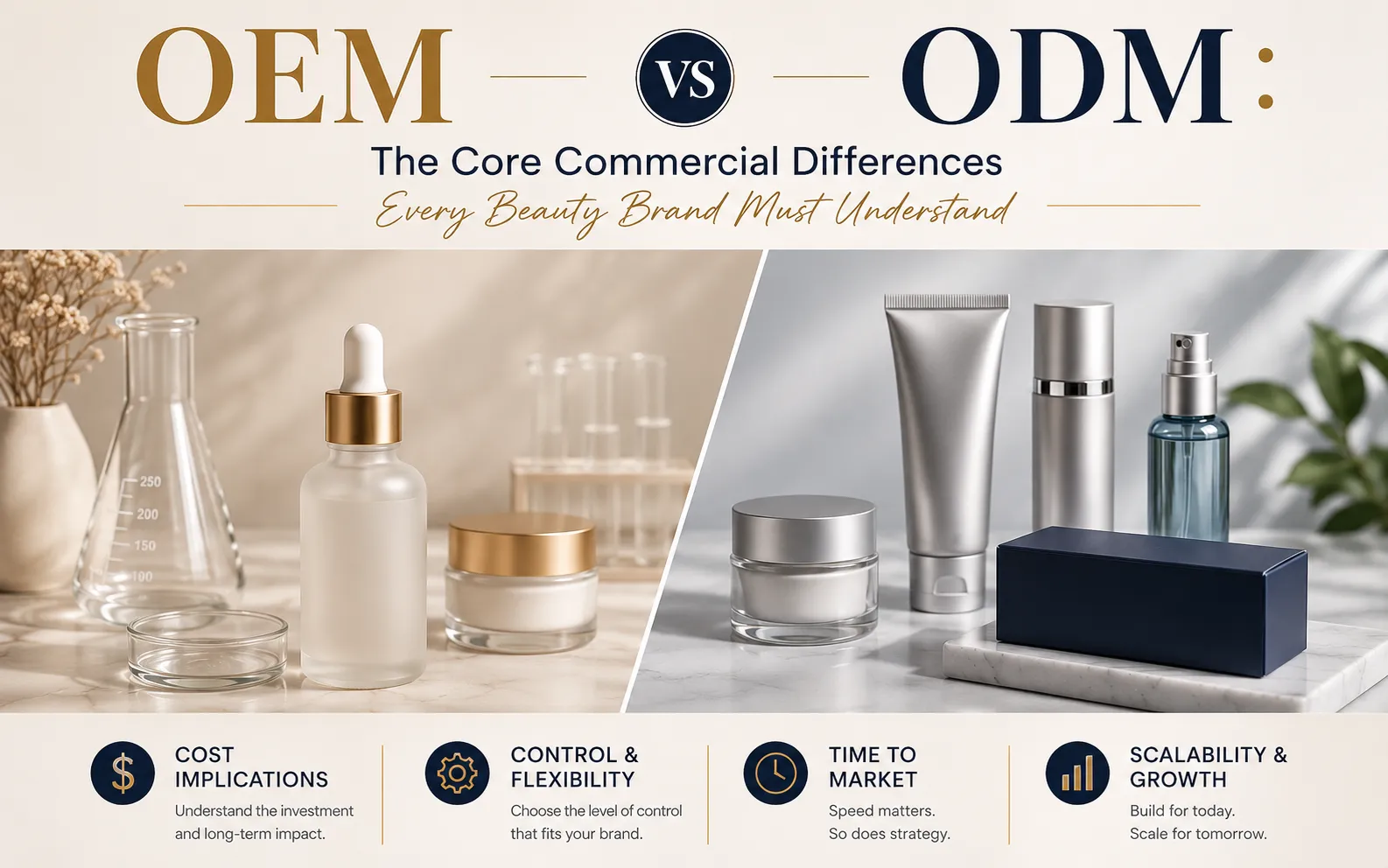
Your timeline reality. Custom formulation (true OEM) takes four to eight months from brief to shipment. If you need product in 60 days, you're looking at ODM — pre-developed bases you customize. Both are valid paths. What's not valid is expecting OEM speed from an ODM budget and timeline. We broke this down in detail here.
Your non-negotiables. Pick three things you absolutely won't compromise on. Examples: "must have on-site microbiology lab," "must accept third-party audit before deposit," "must provide batch-level heavy metal testing." Everything else is negotiable. Without this list, you'll get talked into accepting whatever the factory prefers.
Your actual budget. Not your wishful-thinking budget. If you have $8,000 total for product development, own that. A good manufacturer will tell you what's realistic within that constraint rather than overpromising and underdelivering.
The Factory Visit — Or the Virtual Equivalent
If you can physically visit the factory, do it. There is no substitute for walking a production floor. You'll see things in five minutes — the condition of the homogenizer, whether raw materials are properly labeled and dated, how staff move through the space — that fifty Zoom calls won't reveal.
If you can't visit in person, demand a live video walkthrough. Not a pre-recorded tour. A real-time call where you can say "show me the water treatment system" or "turn left — what's in that room?" A factory that refuses this request has something to hide. Walk away.
Whether in-person or virtual, look at these specific things:
The Water System
Skincare is mostly water. If the factory's water treatment looks like an afterthought — a single undersized RO unit, no deionization, no UV sterilization loop — the microbial stability of every product they make is suspect. A real cosmetics manufacturer has a serious water setup: multi-stage reverse osmosis, electrodeionization, a recirculating distribution loop, and daily microbial monitoring logs they can show you.
The Lab
Count the people. A factory with a two-person "lab" cannot properly support custom formulation, incoming raw material testing, in-process QC, finished product testing, and stability studies. You're looking for at minimum a team of five to eight technical staff — a mix of formulation chemists, QC analysts, and a regulatory documentation person.
Ask to see a sample Certificate of Analysis. If it only lists appearance, odor, pH, and viscosity, the QC program is cosmetic in name only. A real CoA includes microbial limits (aerobic plate count, yeast/mold, specified pathogens), specific gravity, and — depending on the product — preservative content assay, active ingredient percentage, and particle size distribution.
The Raw Material Warehouse
Open a drum. Ask what's in it, where it came from, when it arrived, and when it expires. A well-run warehouse has every container labeled with material name, lot number, receipt date, retest date, and storage condition. A poorly run one has unlabeled containers, expired materials mixed with fresh stock, and no temperature monitoring. The condition of the warehouse predicts the consistency of your product.
Five Red Flags That Cost Me Money So You Don't Have To
I've made most of these mistakes personally. Learn from them.
The "sure, we do that" factory. Some factories will claim capability in every product category — skincare, hair care, color cosmetics, men's grooming, baby products. A factory that does everything probably excels at nothing. The best manufacturers have a specialty. Ask: "What three product types are you best at?" If they can't name specific categories, they're a generalist. Generalists are fine for commodity products. They're dangerous for anything requiring formulation expertise.
The suspiciously low MOQ. Mass-production cosmetics manufacturing involves minimum batch sizes dictated by tank capacity. A mixed batch might yield 200 to 500 kg — which translates to roughly 2,000 to 5,000 units of a 100ml product, depending on filling losses. If a factory offers 100-piece MOQs with no credible explanation of how they manage that economically, you are almost certainly talking to a trading company that's aggregating orders. Trading companies aren't inherently bad — some provide genuine value in logistics and communication — but if they present themselves as the factory, that deception poisons the relationship from day one.
The reluctant reference. Every decent manufacturer has clients who will vouch for them. Ask for contact information for three current clients with product categories similar to yours. If they hesitate — "confidentiality concerns" is the usual excuse — they may not have satisfied clients, or their clients may be direct competitors they don't want you to discover.
The price that doesn't add up. Get three quotes. If one is 40% below the others, something is being cut — raw material quality, preservative system robustness, packaging grade, or staff training. Ask the cheap factory to explain their cost advantage in detail. A legitimate answer might be "we buy this surfactant in 20-ton quantities and pass the savings on." A red-flag answer is "we have our own way of doing things."
The disappearing contact. After you place your deposit, does the responsiveness change? Send a test email at an odd hour before signing. A factory that takes five days to respond during the courtship phase will take five weeks once they have your money. Good manufacturers are busy but responsive. Bad ones are responsive until they're paid.
The Chemistry Test: Five Questions to Ask During Your First Call
You don't need to be a formulation chemist to assess whether you're talking to a real manufacturer or a middleman. Ask these questions and listen to the answers:
"Walk me through your preservative efficacy testing. How many challenge organisms do you test against, and what standard do you follow — USP 51, ISO 11930, or something internal?" A real manufacturer answers this immediately, with specifics. A middleman says "our lab handles that."
"If I need to adjust the viscosity of my emulsion post-pilot, what's your approach — thickener addition, homogenization adjustment, or surfactant ratio modification?" There's no single right answer, but there are wrong ones. "We just add more thickener" without qualification is a red flag.
"Show me your last three out-of-specification investigations. What went wrong, and what changed as a result?" Every manufacturer has OOS events. Good ones document them, investigate root cause, and implement corrective actions. Bad ones pretend they never happen.
"What's your policy on raw material substitution if my specified ingredient goes on allocation or has a price spike?" The answer tells you whether they'll communicate proactively or just swap ingredients and hope you don't notice.
"How do you handle the Product Information File — do you maintain it, do I get a copy, and what happens to it if we part ways?" This question alone has saved brands from being held hostage by manufacturers who retain the formulation dossier.
Contracts: The Section Nobody Reads but Everyone Regrets
Your manufacturing agreement is the most important document you'll sign and probably the one you'll read least carefully. Pay attention to these clauses:
Formula ownership. If you paid for custom formulation, the formula is yours. The contract must explicitly state this. Without that clause, in many jurisdictions the manufacturer who developed the formula retains ownership by default — even if you paid for the development work. I've seen brands pay $25,000 for custom formulations only to discover, when trying to switch factories, that they didn't legally own what they'd paid for.
Exclusivity. If you're licensing a factory's base formula (ODM), negotiate market or channel exclusivity. At minimum, the same base should not be sold to a direct competitor in your primary market. Get this in writing.
Raw material traceability. The contract should give you the right to request batch-level raw material documentation — certificates of analysis from the factory's suppliers, not just the factory's own incoming inspection. If a raw material issue causes a quality problem, you need traceability to determine whether it's a factory error or a supplier issue.
One Last Thing
The manufacturer you need today might not be the manufacturer you need in three years. That's fine. The startup-friendly MOQ factory that gets your first 1,000 units to market may not be the right partner when you're doing 50,000 units. Plan for the transition. Keep your formula files organized. Maintain relationships with backup suppliers. And never, ever let a single manufacturer become the only place that can make your product.
This guide was written from direct industry experience. For specific sourcing questions, browse our OEM/ODM product capabilities or reach out through our contact page. For the shampoo-specific version of this guide, see How to Find a Reliable Shampoo Manufacturer.