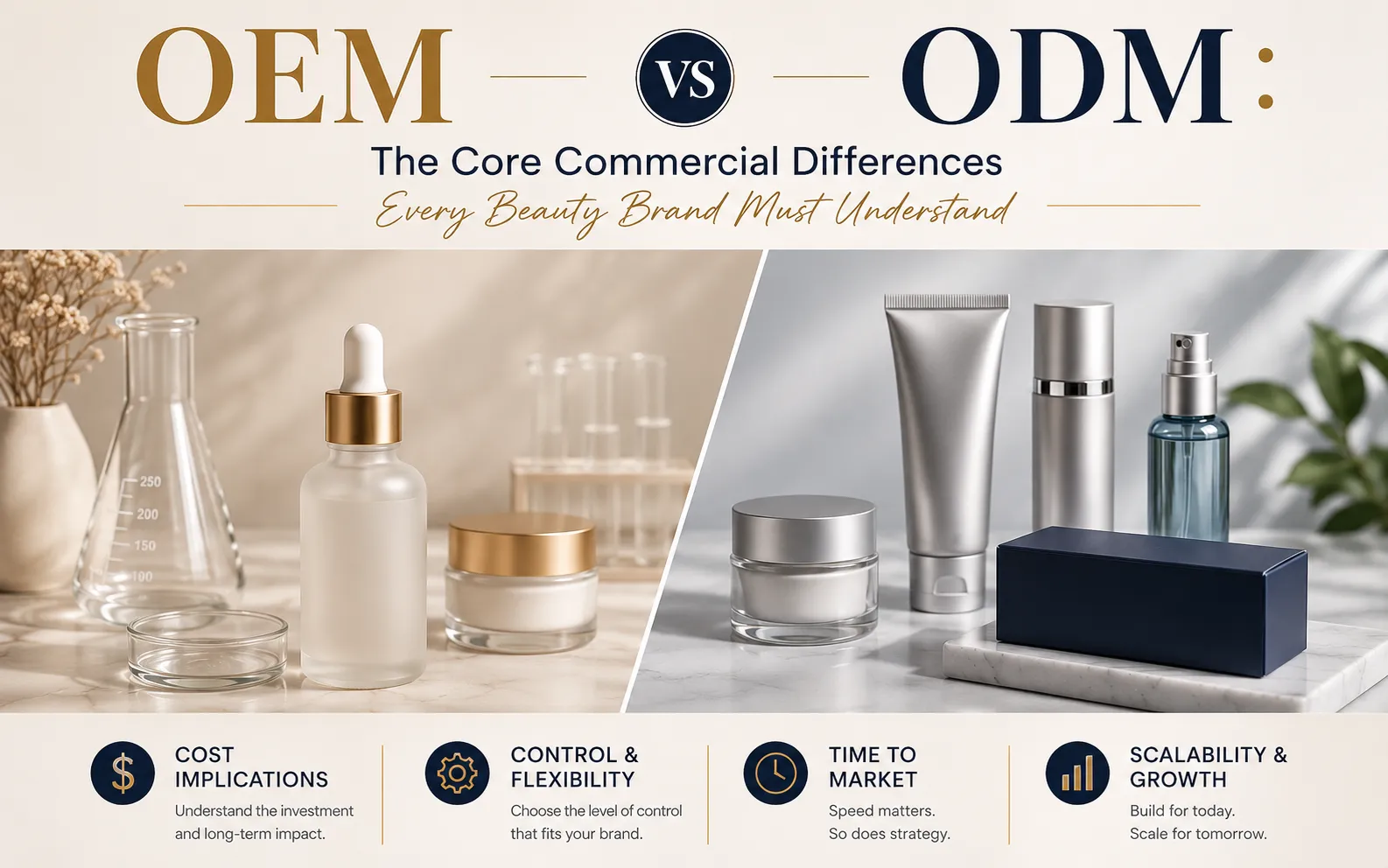
Introduction: Two Paths, One Goal
Every beauty entrepreneur eventually faces the same fork in the road: OEM or ODM? These two acronyms represent fundamentally different manufacturing philosophies, each with distinct implications for your brand identity, product development timeline, upfront investment, intellectual property ownership, and long-term scalability. Choosing the wrong model can cost you months of rework and tens of thousands of dollars.
Yet many first-time brand owners sign manufacturing agreements without fully understanding which model they're committing to — or worse, without realizing they had a choice at all. This guide clarifies the commercial reality of both approaches so you can make an informed decision grounded in your specific business goals.
1. Definitions: What OEM and ODM Actually Mean in Cosmetics
OEM — Original Equipment Manufacturing
In the cosmetics context, OEM means you bring the formula, the factory executes it. You — or your contracted formulation chemist — develop the product specification: surfactant system, active ingredient percentages, preservative regime, fragrance profile, viscosity target, pH range, and sensory characteristics. The manufacturer's role is to source approved raw materials, scale the batch, fill, package, and deliver finished goods that match your specification.
You own the formulation IP. The manufacturer cannot reproduce your formula for another client without your consent (provided your contract includes appropriate IP clauses).
ODM — Original Design Manufacturing
ODM means the factory offers pre-developed, market-tested formulas that you customize superficially. The manufacturer already has a library of shampoo bases, conditioner matrices, and treatment prototypes. Your customization options typically include fragrance selection, color adjustment, active ingredient addition (within compatibility limits), and packaging design. The underlying formula remains the manufacturer's IP.
The factory owns the base formula. You're essentially licensing it — albeit exclusively or semi-exclusively, depending on your agreement.
2. The Commercial Trade-Offs at a Glance
| Dimension | OEM | ODM |
|---|---|---|
| Formula ownership | Yours | Factory's |
| Time to market | 3–9 months | 2–6 weeks |
| Upfront investment | $5,000–$50,000+ (formulation + testing) | $500–$3,000 (customization fees) |
| Minimum order quantity | Typically higher (1,000–5,000 units) | Lower (500–1,000 units) |
| Differentiation potential | Unlimited — fully custom | Limited to surface modifications |
| Regulatory responsibility | Shared — you own the formula file | Factory holds the master formula dossier |
| Scalability | You control the supply chain | Factory controls raw material sourcing |
| Best for | Established brands with unique IP | Startups testing market fit |
3. When OEM Is the Right Choice
OEM manufacturing makes sense when your competitive advantage is a unique formulation that cannot be replicated with off-the-shelf bases. This is particularly relevant for:
- Performance-driven brands — If your brand promise hinges on a specific active ingredient complex (e.g., encapsulated retinol, fermentation-derived peptides, cold-pressed botanical infusions), OEM ensures you control the formula integrity.
- Clinically-positioned products — If you intend to conduct third-party efficacy studies and publish results, you need a formula you own.
- Multi-market compliance — When launching simultaneously in the EU, US, and Asia, you need the ability to modify the preservative system, sunscreen actives, or restricted ingredients per market — which requires formula ownership.
- Exit strategy — Brands built on proprietary IP command significantly higher acquisition multiples. Distributors and strategic buyers value formula ownership.
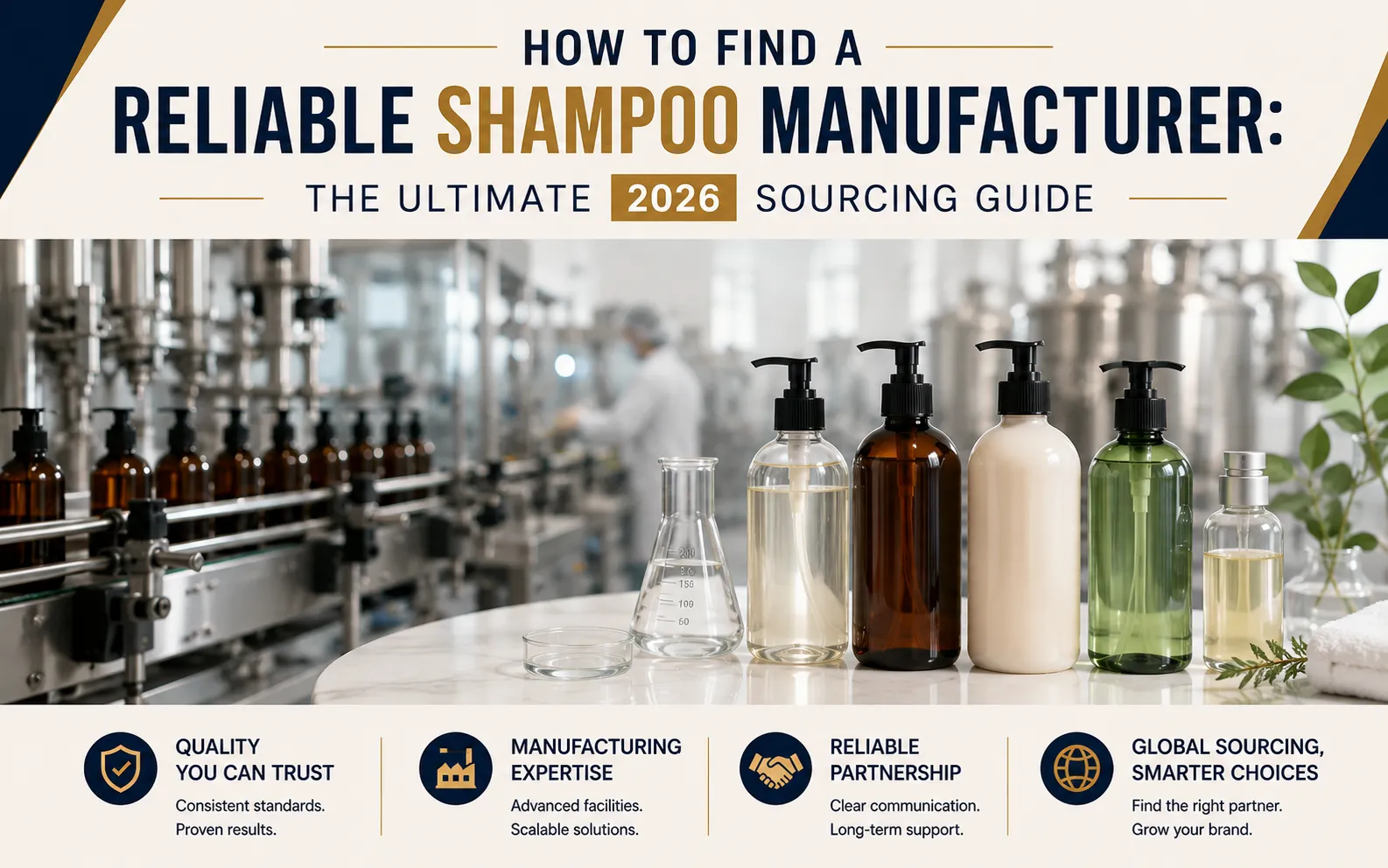
For a thorough walkthrough of finding the right manufacturing partner, read How to Find a Reliable Shampoo Manufacturer: The Ultimate 2026 Sourcing Guide.
4. When ODM Accelerates Your Launch
ODM is not a compromise — it's a strategic accelerator for specific business scenarios:
- Speed-to-market — You can go from concept to cargo in 30 days with an ODM partner that already has stable, tested bases ready for customization.
- Capital efficiency — Without the $15,000–$40,000 upfront cost of custom formulation and stability testing, you can allocate more budget to branding, packaging design, and customer acquisition.
- Market validation — Launch with an ODM product, gather real consumer feedback, and only then invest in custom OEM development for your second-generation formula.
- Trend responsiveness — When a trending ingredient (e.g., batana oil, rice water, rosemary extract) surges, ODM partners often already have compatible bases, enabling you to ride the trend before it peaks.
A great example of an ODM-ready product category is the booming natural hair growth segment. Read how brands are leveraging this in our Batana Oil Hair Regrowth Natural Treatment Guide.
5. The Hybrid Model: The Best of Both Worlds
Increasingly, sophisticated brands are adopting a hybrid approach:
- Launch Phase (ODM): Enter the market quickly with an ODM base, customized with your selected fragrance, active boost, and premium packaging.
- Growth Phase (Semi-OEM): As sales data validates demand, commission the factory's R&D team to develop a custom variant of the ODM base — adjusting the surfactant ratio, adding your proprietary active complex, and optimizing the preservative system.
- Scale Phase (Full OEM): Once you've established market share and have the capital, invest in a fully custom OEM formulation that becomes your defensible brand asset.
This staged approach minimizes upfront risk while preserving the long-term path to IP ownership.
6. Contract Essentials Regardless of Model
Whether you choose OEM or ODM, your manufacturing agreement must explicitly address:
- Exclusivity: Does the factory retain the right to sell your formula (or its base) to other brands?
- Raw material traceability: Can you audit the supply chain for your batch?
- Defect liability: What is the AQL (acceptable quality limit), and who bears the cost of rejected batches?
- Minimum order quantity adjustment: Can MOQs decrease after the first production run?
- Termination & formula transfer: If you switch manufacturers, can you take your formula file with you?
7. Making the Decision: A Practical Framework
Ask yourself these five questions. If you answer "yes" to three or more, OEM is likely your path:
- Do you already have a proprietary formula or access to a formulation chemist?
- Is your brand positioning built on a unique active ingredient story?
- Do you have the capital to invest $15,000+ in formulation and stability testing?
- Are you planning to sell in multiple regulatory jurisdictions simultaneously?
- Is an acquisition or exit part of your 5-year business plan?
Otherwise, start with ODM, build your brand, and transition to OEM when the market validates your concept. For a real-world example of a brand that can work in either model, see how salon owners approach Private Label Hair Color Cream.
Conclusion
OEM and ODM are not "good" versus "bad" — they're strategic tools for different stages of brand development. OEM rewards patience and capital with true IP ownership and unlimited differentiation. ODM rewards speed and agility with fast market entry and low upfront risk. The brands that win are those that choose deliberately based on their current reality — not those that default into one model without understanding the other.
Ready to discuss which model fits your brand? Explore our OEM/ODM capabilities or contact us for a personalized consultation.